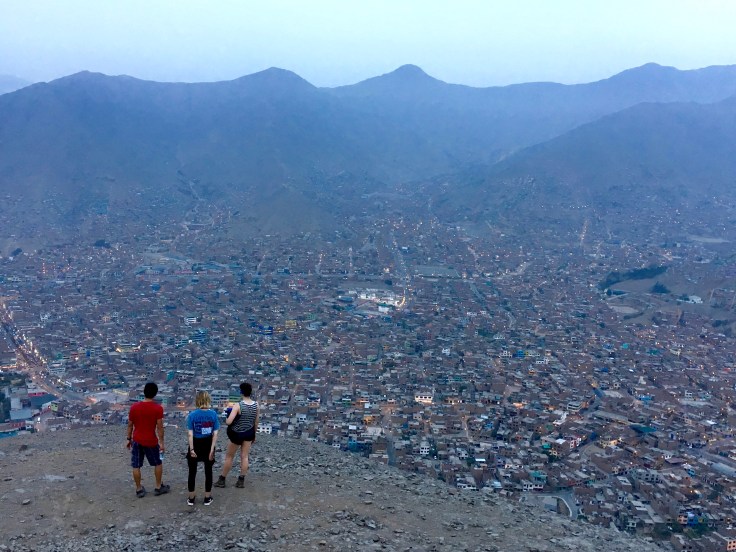
Why am I talking about Huaycán? Because I started volunteering for a non-profit organization a week ago, in this community. Let’s start with some history and facts.
History & facts
The urban community of Huaycán is a suburb of Lima and is located in the Ate district, about 16km from Lima. About 30 years ago, immigrants settled here from different parts of Peru, looking to improve their standard of living and job opportunities in the city of Lima. They created the city from scratch, installing step by step houses, electricity and water access.
In 1984, the “Special Project for the Urban Development of Huaycán” (PEHUH) was established. Housing associations and cooperatives were assigned the lower part of Huaycán, which today corresponds to zone A, while human settlements would be located in the upper areas. These groups carried out the seizure of the lands in an organized and peaceful manner. People began arriving with thousands of families.
At the end of the decade of 1980, Huaycán became one of the scenarios of urban terrorist violence. In 1986, the APRA leader of Huaycán, Andrés Tapia, was allegedly killed by members of Sendero Luminoso. In 1987, the population of Huaycán began a series of marches in rejection to terrorist violence, and requesting the titling of their homes, as well as greater attention from the government regarding basic water and electricity services.
During the 1990s, President Alberto Fujimori established a Peruvian Army base in Huaycán, which executed both a control plan and civic actions consisting of the distribution of provisions and the construction of public works.
In January 2017, the Permanent Commission of the Peruvian Congress approved the ruling declaring the districtization of Huaycán of national interest. The project was approved and is the beginning of the legal procedure for the creation of the new district of Huaycán, the author of the proposal is the congresswoman Fujimorista Úrsula Letona. The new municipal jurisdiction would have 27.40 km2 of surface and a population of 160 thousand inhabitants, 25% of the population of Ate.
My experience so far
And now, my personal opinion. If I had to choose one word to describe this place, it would be… dusty! I’ve literally never seen this much dust in my life (and I’ve lived in India). But you get used to it. And I didn’t bring really nice clothes so it makes is easier to adapt. But it doesn’t take away the amazing colors you’ll find everywhere. People paint their houses in vivid colors, it gives it such brightness and joy, it’s amazing.
At first, I thought it was going to be a sort of favela with nothing to do but one of the predominant economic activities in Huaycán is commerce. The main avenue, the 15 de Julio, has a lot of shops and street stands, as well as a main market with delicious fruits and vegetables for a very affordable price (6 soles per kilo for good avocados).
I must point out the security, though. I feel rather safe in my house and in the main streets, but this place si not safe, even the locals say so. We’re working with kids from different zones of the city and some come to the center with pocket knifes because they have to walk back home after dark. We go out in groups, without any bags nor “pretty” things, just to make sure. I guess this makes it look like a horrible place but I’m sure this is a reality in most places but we’re just not aware of it. And the problems are mainly theft, not assault, so you just have to be smart and cautious.
On the either had, people are super friendly and really sweet. They will always help us if we need any kind of assistance and they don’t ask for anything in return. They are happy with what they have and express so much gratefulness and sharing spirit. They are really eager to learn, improve and are curious about what us gringos can offer. So I guess it makes up for the bad aspects of the city.
I’ll soon post an article on the organization I’m volunteering for, but I wanted to have more intel before doing so. In the meantime, don’t hesitate to check out the website: Light and Leadership Initiative and its fair trade brand Huaywasi.
 Just meets World
Leave a comment